
By Donal Byrne
01 · Introduction
I have done tech startups all my life. I was on the front line of the .com bubble in Silicon Valley and the global telecom bubble. We worked weekends, pulled all-nighters, and laughed at the concept of work-life balance. Tech was our life and nothing got in the way of us trying to achieve our startup ambitions. Looking back, I would say it might not have been the smartest approach, but that is what the environment demanded, and most of us survived to tell the tale. Truth is, I came close to not getting out the other side, and hence my motivation to now do something about it.
For the past two years I have immersed myself in AI with the goal of building another new company with my co-founders. This time a health tech company. AI is frankly amazing and powerful and exciting and concerning, all at once. I initially thought we could build this with a few additional people and a swarm of AI agents. Ultimately, we would be able to play lots of golf (our collective passion), meet clients, and let AI take care of everything else.
Not the case. Every day I feel:
- I don't have time.
- I can't keep up.
- I am anxious because I don't understand everything.
- I feel guilty because I am using someone else's work (the AI).
- I worry about the agents going off-script.
- I feel I have to push harder.
Turns out all my friends and colleagues share these same feelings. I am lucky. I thankfully have a lot of things going well in my life. But if I am feeling this way, others are going to have a much tougher time.
I have been through the grind before, and I know what a hard startup feels like. This is not that. The AI-first work environment is different. It feels different. It hits different. The question I could not shake was why, and the answer turned out to be more interesting than I expected.
02 · Why the AI workplace hits different
The obvious objection is that startups have always run full-throttle. That is fair. In my days in Silicon Valley there was a well understood, unwritten rule: you could generally survive about 2 years of startup grind. It was always interesting when companies hit their 2-year anniversary without an exit. Work policies changed. People were no longer asked to sacrifice their weekends. All-nighters became few. Burnout and fatigue were common, and people started to silently leave and move on.
So intensity is not new. What is new is the kind of intensity.
The old grind was mostly about time and effort. The hours were long, but the work itself was human-paced. You did the task. You thought, you built, you shipped, and there were natural gaps in the day where the mind could recover. AI-first work is different in nature, not just in degree. You are no longer doing the task, you are supervising several streams of it at once. You direct a swarm of agents, review what they produce, decide what to keep, and catch what goes wrong, continuously. The decisions come faster and thicker, the context switches are constant, and the pace is set by the tools rather than by you. Much of the day is spent verifying machine output rather than talking to people, so the human contact that used to break up the work has thinned out too.
The result is a load that lands on attention and judgment rather than on the clock. And it appears to arrive faster. It is also accompanied by a more acute sense of enormous opportunity and simultaneous fear of overnight extinction.
Today, the same silent exit I used to see at the 2-year mark seems to be happening in AI-first companies at around 18 months. There is no official study on this, and no HR department will admit it, but it is well known within AI circles. Ask anyone in the frontier labs, or go onto LinkedIn and look at the average tenure of AI professionals.
If the intensity is not the new thing, and it is down to the nature of the cognitive load, then the question becomes what that load is actually running on. To answer that, we have to look at the machine doing the work, the human brain, and how it evolved.
03 · Three million years in the making
The brain reading this sentence was built for a different world. For most of human history, cognitive work and problem solving did not happen at a desk. It happened on the move, in a group, with the body working and other people close by.
Our ancestors solved problems while walking, foraging, tracking, and building, and they did it as part of a community. Movement, cognition, and social connection were not separate activities. They were integrated into one way of living, and the brain adapted to expect all three at once. The evolutionary neuroscientists David Raichlen and Gene Alexander make this concrete in their Adaptive Capacity Model: the human brain evolved to depend on physical activity, and we are, in their words, "cognitively engaged endurance athletes." The influential social-brain hypothesis makes the parallel case for connection, arguing that the size and power of the human brain were driven in large part by the demands of living in groups.
The modern AI workplace keeps the thinking and strips out the other two. People sit still for most of the day, often alone behind a screen, while the cognitive load climbs higher than at any point in that long history. That is the mismatch. We are asking the most demanding cognitive work ever asked of employees from a brain that expects to move and to belong, and we are giving it neither.
This is not just a tidy theory. The cost is already starting to show up in the data.
04 - The injury report
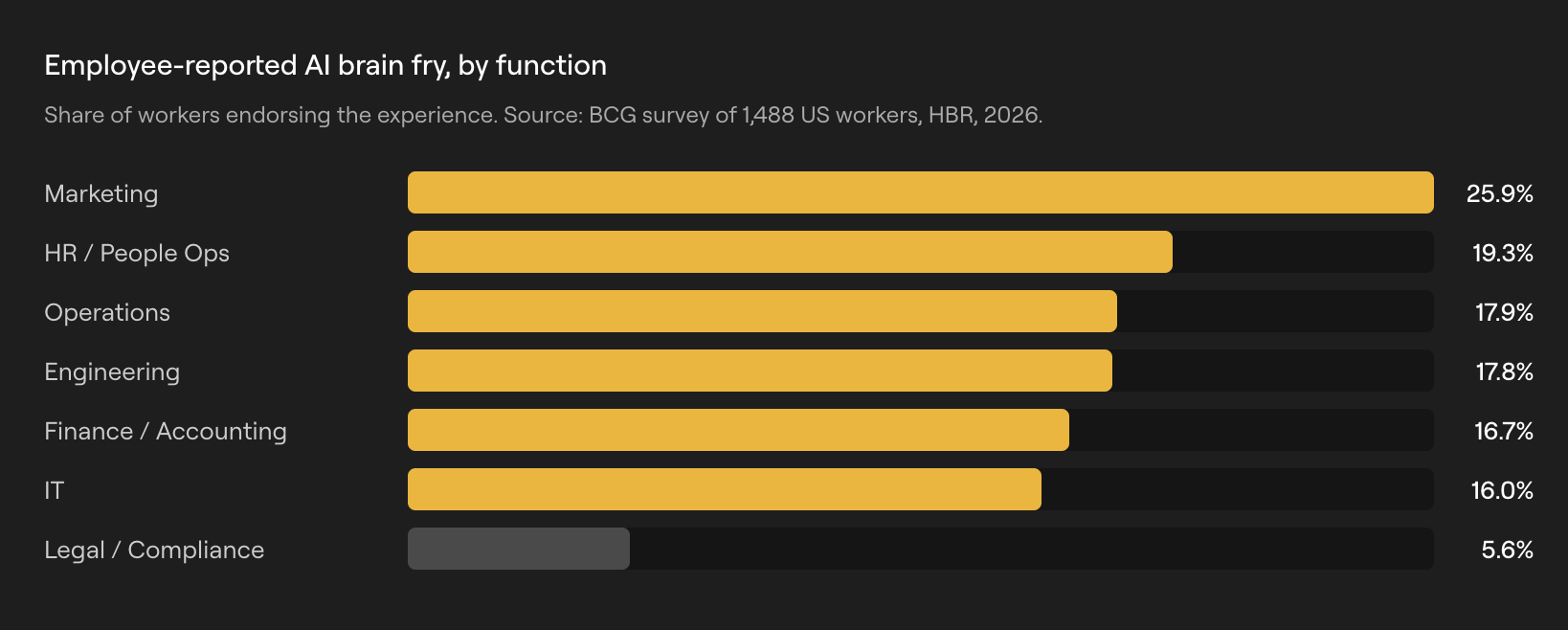
The early evidence of mismatch is emerging. A 2026 study of 1,488 US knowledge workers by BCG, published in Harvard Business Review, named a condition the researchers call "AI brain fry": mental fatigue from overseeing more AI than a person can hold in mind at once. They report it as distinct from burnout, which is emotional and slow. AI brain fry is acute strain on attention, working memory, and executive control.

Read the last figure twice. The people most affected are the heaviest, most capable users of AI, the ones a company least wants to lose. The same study found a hard performance ceiling: output climbs as workers move from one to three simultaneous AI tools, then falls. More is not free, in agents or in effort. And the strain is highest exactly where an AI-first company creates its value.
AI brain fry is the hidden cost of AI productivity.
One more interesting finding from the same dataset hints at a potential fix. Employees who felt their organization genuinely valued their health reported 28% lower mental fatigue, and workers who freed up time reported more social connection and less fatigue. The protective factors showed up inside the exact study that defined the problem.
05 - Stick Or Twist Or Re-frame?
We know the human brain is not adapted for this new environment. Expecting companies and AI knowledge workers to slow down, or putting on the brakes, is naive and is simply not going to happen.
What to do?
Sticking with the status quo is not likely to end well for both company and employee; at least not as well as it could.
Going down the traditional employee wellbeing route will be a hard sell to executive leadership and hard-charging AI professionals. Eyes will roll. I don't think it lands.
We need to re-frame the problem and the potential solution.
PROBLEM REFRAME - The AI workplace is more challenging for our knowledge workers to perform at their full potential, safely.
WORKPLACE REFRAME - AI-first companies need to evolve the workplace for sustained human performance of AI work.
SOLUTION REFRAME - Movement and social connection become workplace infrastructure.
The analogy is the sports organization. It would be unthinkable for a professional sport team not to have strength and conditioning infrastructure for their team. The AI workplace needs the same mindset. It needs cognitive "strength and conditioning" infrastructure. The best-conditioned team, cognitively, gains advantage.
06 - The Two Missing Biological Inputs
Movement and social connection are the two mechanisms with the strongest evidence base for protecting and sharpening the brain, and they happen to target the exact faculties AI brain fry attacks.
Mechanism one: Movement
Aerobic and resistance work, dosed and recovered, sharpens attention and executive function acutely and builds reserve over time.
Mechanism two: Social Connection
Belonging buffers the stress that degrades those same faculties, and social interaction itself works attention, memory, and processing speed.
Movement conditions the brain that does the work
Neurologists Dean and Ayesha Sherzai explain that, of all the faculties exercise touches, the two it improves most powerfully are attention and executive function, the processing and problem-solving at the center of knowledge work. They treat exercise as a dose-response intervention for the brain, not a vague good habit, with the strongest effects from a combination of aerobic and resistance training.
Andrew Huberman describes the acute side: a single well-dosed session raises alertness, cognitive flexibility, and recall in the window right afterward, driven by a rise in adrenaline and norepinephrine and a surge of blood flow that the brain, in his phrase, "craves all the time."
The effect is measurable at both ends of the time scale. A single bout of activity produces a small, repeatable acute lift in cognition. Reviews of sedentary behavior associate long hours of sitting with worse global cognition, executive function, and memory. The brain that is never asked to move loses capacity it would otherwise keep.
Real conditioning is dosed, not maximized. Athletes load, recover, and peak, because more volume is not always better, and the brain follows the same rule. Too much high-intensity work reduces cerebral blood flow and performance drops, the same shape as the study's three-tool ceiling. We need the right dose to be applied with the right frequency for optimal results.
Social connection is the second active ingredient
Social connection is not only critical for how you get people to show up. It protects cognition in its own right. Social support buffers the stress response that wears down executive systems, and a felt sense of belonging shifts people from seeing a hard day as a threat toward seeing it as a challenge, which lowers perceived stress. Since brain fry is acute strain on those same systems, belonging protects the very hardware the work overloads.
The scale of the social connection evidence is easy to underrate. A meta-analysis by Julianne Holt-Lunstad and colleagues found that stronger social relationships are associated with a 50% higher likelihood of survival, an effect the authors place alongside well-established risks such as smoking. The 2023 US Surgeon General advisory synthesized this into a public warning, reporting that social disconnection carries a mortality association it compares to smoking up to fifteen cigarettes a day, with about half of US adults reporting measurable loneliness. Social connection is one of the best-documented predictors of health we have, and the workplace needs to provide it if it expects its people to spend over one-third of their lives there.
Movement and social connection are not workplace perks. They are two evolutionary requirements for sustained human performance.
07 - Rethinking the workplace
We cannot put the AI genie back in the bottle. AI is here to stay. No one is giving their agents back.
Any suggestion to pull back or slow down will fall on deaf ears. The obvious answer is that we need to re-balance the AI workplace with infrastructure that provides movement and social connection to protect and enhance human performance.
We need to build movement and social connection into the AI workplace through intentional workplace design. Two mechanisms, one target, delivered together.
08 - A final point
The AI workplace is one of the most cognitively demanding environments for the human brain. Movement and social connection are the two mechanisms three million years of evolution have wired in, and they are exactly what the AI working environment strips out. Put them back, and you protect the brain doing the most demanding work you have ever asked of it. That is the environment worth building, and it is the one we are focused on in NestEgg.
I can't finish this paper without highlighting the "elephant in the room". I have not addressed how do you get the AI knowledge worker, who has no time, is overworked, is stressed, to move and connect? This is the really hard part of the problem. This question became our starting point for what we have built at NestEgg. The answer for how we do it might surprise you. I will cover it in part 2 of this series. Thank you.
Sources and notes
- Bedard, Kropp, and colleagues. "When Using AI Leads to 'Brain Fry'." Harvard Business Review, 2026. BCG survey, n=1,488 US workers. Figures cited: +33% decision fatigue, +39% major errors, intent to quit rising from 25% to 34%, the three-tool productivity ceiling, prevalence by function, and 28% lower mental fatigue where the organization is felt to value wellbeing.
- Raichlen DA, Alexander GE. "Adaptive Capacity: An Evolutionary Neuroscience Model Linking Exercise, Cognition, and Brain Health." Trends in Neurosciences, 2017. The "cognitively engaged endurance athletes" framing and the argument that the brain evolved to depend on physical activity.
- The social-brain hypothesis (Dunbar and colleagues): the proposition that human brain size and cognition were driven substantially by the demands of group living.
- Sherzai D and Sherzai A. "Exercising for Brain Health." The Proof Podcast, EP 226. Attention and executive function as the faculties most improved by exercise; dose-response framing; aerobic plus resistance combination.
- Huberman A. On acute arousal through adrenaline and norepinephrine, cerebral blood flow, cognitive-flexibility and recall gains, and the reversal at excessive intensity.
- 2024 Lancet Commission on dementia prevention, intervention, and care (Livingston and colleagues): physical inactivity among the modifiable risk factors associated with preventable dementia cases.
- Systematic reviews of sedentary behavior, cognition, and brain health (older-adult cohorts): greater sedentary time associated with worse global cognition, executive function, and memory, and with higher risk of cognitive decline.
- Holt-Lunstad J, Smith TB, Layton JB. "Social Relationships and Mortality Risk: A Meta-analytic Review." PLOS Medicine, 2010. Stronger social relationships associated with roughly 50% higher likelihood of survival.
- US Surgeon General. "Our Epidemic of Loneliness and Isolation." HHS, 2023. Mortality association compared to smoking up to fifteen cigarettes a day; about half of US adults report loneliness.